Seeing is believing: timber construction is truly circular.
Some claims regarding circularity cannot always be verified immediately. It is nice that the opportunity presented itself now.
With solid timber construction (CLT and Glulam), the idea is that the building can be dismantled after the end of its lifespan and the various components reused. But then again, the lifespan of a residential building is typically 50 years or longer.
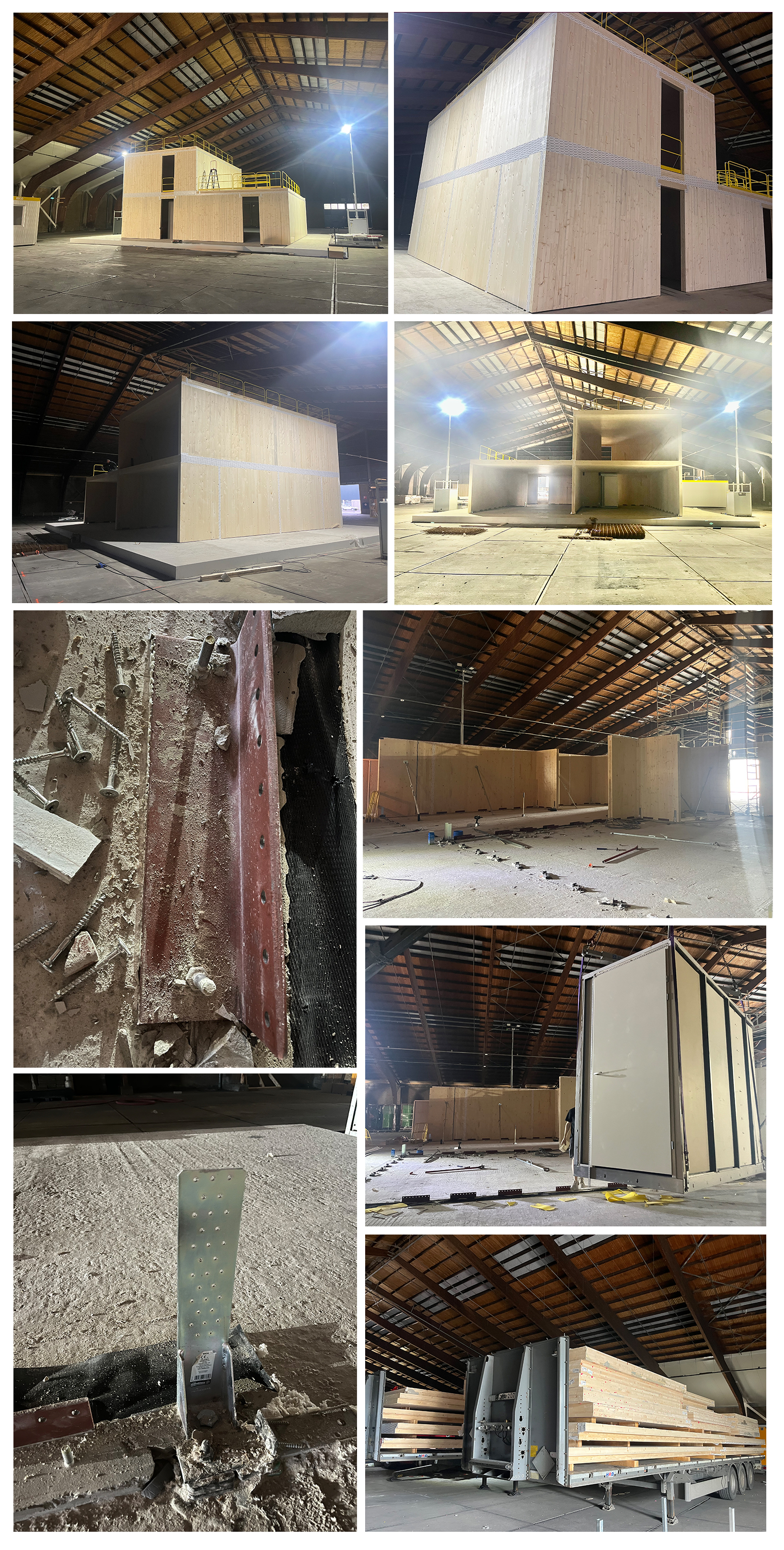
As part of the preparations for the BoogieWood project commissioned by VORM, HAMLET built a mock-up six months ago, fully conforming to the structural design of the final building. The mock-up consisted of 3 apartments with a total surface area of over 180 m² and, due to a lack of space outside, was constructed in a hall next to the construction site.
VORM completed the mock-up entirely, including a prefab bathroom, plaster walls, floor finishes, and facades, and subsequently carried out a number of successful tests (acoustics, load and deflection of the floors, etc.). Just like the final building currently being constructed, the mock-up's structure was assembled entirely using steel anchors and screws.
Last week, the wooden frame was completely dismantled within a day and a half. The screws came out in good condition and were completely intact, including the screw heads and coating (although regulations do not allow for their reuse). Except for a single bent tie rod, the steel anchors were like new. The CLT walls and floors came loose easily and could be loaded onto the truck immediately. The CLT was returned to supplier Hasslacher. Air sealing tape had to be cut open and, naturally, cannot be reused. The Sylodyn used for acoustic decoupling did not survive either. During assembly, the material is secured with a number of small staples so that it cannot blow off during installation (in the open air). If one has plenty of time and patience, the staples could be removed, allowing the acoustic material to come loose completely. The facade elements, plasterboard, and prefabricated bathroom could also be dismantled and are suitable for reuse.
We already knew this, of course, but a well-designed wooden building is truly circular. So now we are putting it to the test.
What is required for this:
- Take detachability into account during the design phase (choice of the type and position of connections).
- Choose high-quality screws and anchors.
- Ensure you have good tools and a skilled installation team (screw heads must remain intact).
- Ensure that no damage occurs to the wood or connections during the finishing phase.
- Ensure you have high-quality finishing partners and the right material choices, particularly for roof finishing, connections, and drainage for wet areas. This minimizes the risk of wood deterioration due to prolonged moisture exposure during the building's lifespan.
Thanks to all partners who made this mock-up possible:
- VORM
- HASSLACHER
- SCHMID SCHRAUBEN
- SIGA
- ISOPARTNERS
- VAN DER WIEL
- SMART 2 PREFAB
- DE KIEVIET